
1928's Happy Warrior
How Al Smith Changed American Politics

The first major party nominee for president who was not a White Anglo-Saxon Protestant was Al Smith, the ebullient Democrat governor of New York, who ran in 1928. Smith was popular, having repealed New York’s state prohibition law and opposed the national version of Prohibition enacted by the 18th Amendment in 1920. He was a progressive in the mold of Theodore Roosevelt and Woodrow Wilson, a champion of laws protecting workers and families, such as worker’s compensation, industrial safety, anti-trust laws, child labor laws, maximum hours, and minimum wages. In New York, like Republican Governor Theodore Roosevelt before him, he sought to align his career with the common man and against the wealthy and powerful. Smith hoped this portfolio would carry him to national office, just as it had Roosevelt.
But Al Smith faced strong political headwinds in the 1928 election. First, he was a Democrat. The Republican Party, the party of Lincoln, held the presidency in an electoral college stranglehold. Over the previous seventy years, Democrats had won only four of the seventeen presidential elections, and two of those were flukes. Woodrow Wilson had only won on 1912 because Theodore Roosevelt, by then a popular former president, had run as a third party candidate, splitting the Republican vote and ensuring that Republican incumbent William Howard Taft would lose. And Wilson was re-elected in 1916 because he promised to keep America out of the First World War. Once elected, he didn’t, and this made the Democrats even more unpopular in the 1920s. And since the election of Republican Warren G. Harding in 1920, Democrats’ fortunes had only sunk farther, as the country had gone on to enjoy eight years of unprecedented prosperity and peace. But if that weren’t bad enough, Al Smith was a Roman Catholic, the grandson of Irish, German, and Italian immigrants.
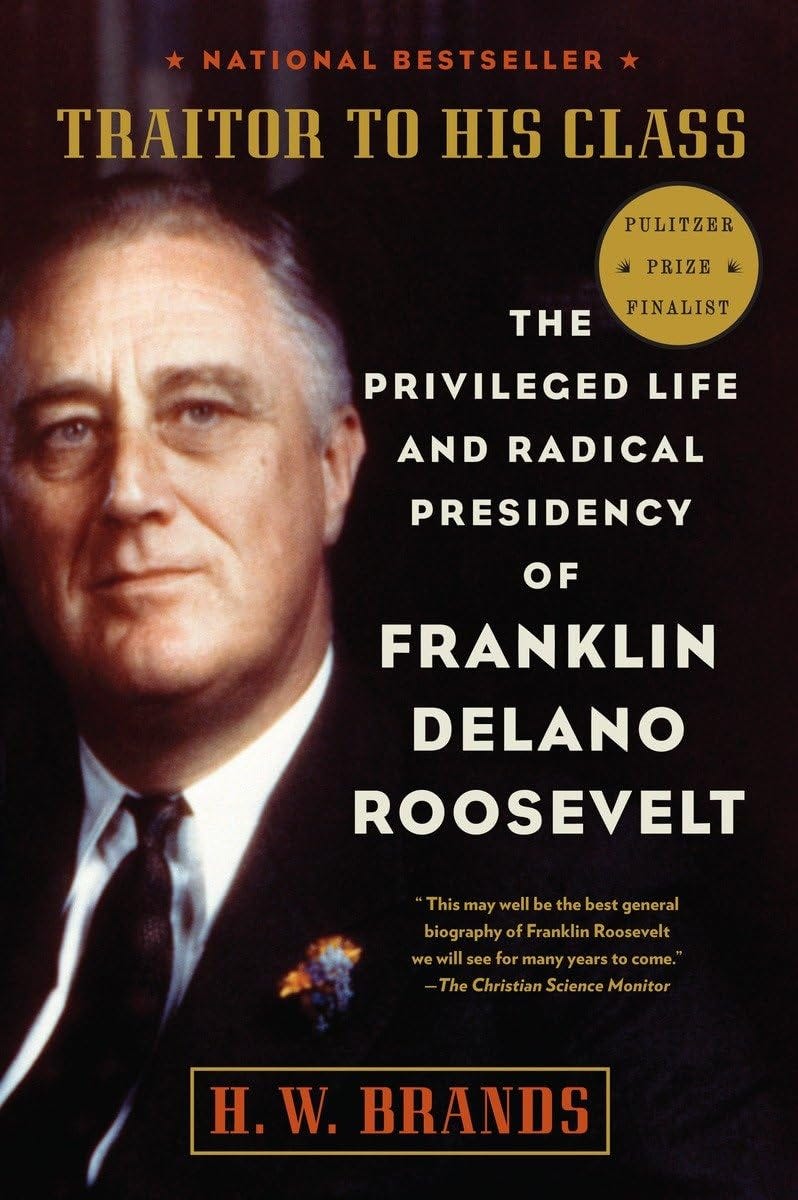
Smith chose fellow New York progressive Franklin Delano Roosevelt, (a Democrat, unlike his cousin Theodore) to give his nominating speeches at the Democratic Conventions of 1924, where Smith’s bid was rebuffed, and of 1928 where Smith won the nomination. Smith also helped persuade FDR to run to replace him as governor in 1928. FDR had been a rising Democratic star, the party’s nominee for vice-president in 1920, but he was struck down by polio shortly after the election and was reluctant to re-enter politics because of his health. The best detailed narration of these events and of Roosevelt’s life and presidency is that of my teacher and mentor, H.W. Brands, titled Traitor to His Class: The Privileged Life and Radical Presidency of Franklin Delano Roosevelt, which was runner-up for the 2009 Pulitzer Prize for Biography.
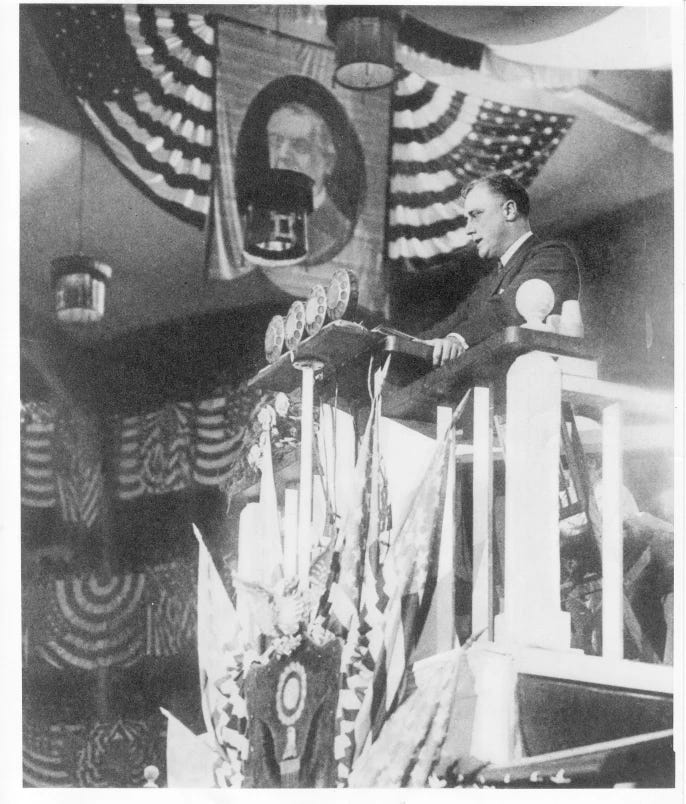
By the time of his 1928 campaign, Al Smith was known to many as “the Happy Warrior,” a nickname FDR used in his 1924 speech, calling Smith “the happy warrior of the political battlefield.” Picture below:1
Happy or not, Smith’s campaign was doomed. Republicans had every reason to expect another landslide fueled by peace and prosperity, and Smith’s religious affiliation made that result even more of a certainty. Indeed, one way of understanding Al Smith’s nomination is that Democrats, with little hope of winning the presidency in 1928, chose a candidate designed to shore up their base among urban ethnic voters and to underline their opposition to Prohibition. That base turned out for Smith but wasn’t enough for him to carry even his home state, which had been trending Republican since the Civil War. Smith carried New York City convincingly but it wasn’t enough to overcome rural and suburban votes for the 1928 Republican candidate, Herbert Hoover. While Smith lost New York state by only a whisker, he did much worse nationwide, carrying only 8 of 48 states and earning only 41% of the popular vote. But his candidacy at the top of the national ticket, together with the Roosevelt name, boosted FDR into the New York governor’s chair. FDR won the state in 1928 by as slim a margin as Smith had lost it in the same election.
The Happy Warrior lost his biggest battle badly. Whether or not he was the right man for the presidency, he sought it at the wrong time. It would be thirty-two years until a Catholic would be elected president, John F. Kennedy. But Al Smith played a pivotal role in American political history by re-introducing FDR, the Democratic Roosevelt, to the national Democratic Party, and by helping him win the governorship of America’s most populous state, a stepping stone to the presidency. When the stock market crashed at the beginning of Hoover’s presidency, his victory in 1928 seemed more curse to him than blessing, and the country turned to FDR and the Democrats in 1932, who would soon change American politics for the rest of the twentieth century. History often hangs on contingent threads like the way Al Smith campaigned and lost, rather than the mere fact he did so. As the saying sometimes goes, for lack of a nail a shoe was lost…and then the battle. It wouldn’t have taken much for things to have turned out very differently.
Photo in the public domain courtesy of Franklin D. Roosevelt Presidential Library and Museum Collections.